Lakh vs Million, Crore vs Billion — Explained Simply
By WordsForNumbers Editorial Team · Updated 2026-09-30 · 32 min read

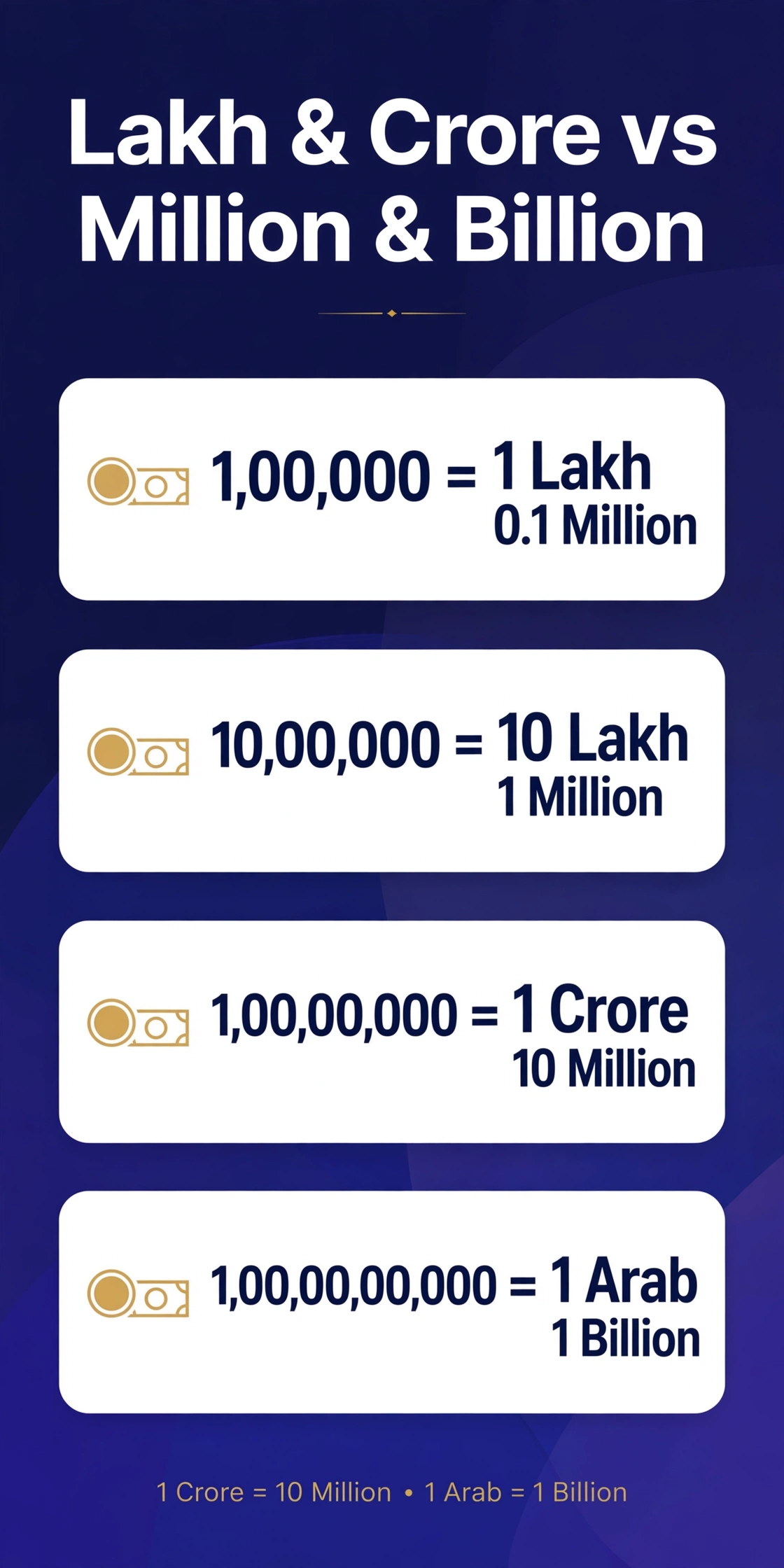
1 lakh = 100,000 = 0.1 million. 1 crore = 10,000,000 = 10 million. 1 arab = 1,000,000,000 = 1 billion. The Indian system (lakh/crore) is used in Pakistan, India, Bangladesh, Nepal and Sri Lanka; the International system (million/billion) is used in the US, UK and most of the world.
Full conversion table
| Indian | Value | International | Value |
|---|---|---|---|
| 1 thousand | 1,000 | 1 thousand | 1,000 |
| 10 thousand | 10,000 | 10 thousand | 10,000 |
| 1 lakh | 1,00,000 | 100 thousand | 100,000 |
| 10 lakh | 10,00,000 | 1 million | 1,000,000 |
| 1 crore | 1,00,00,000 | 10 million | 10,000,000 |
| 10 crore | 10,00,00,000 | 100 million | 100,000,000 |
| 1 arab | 1,00,00,00,000 | 1 billion | 1,000,000,000 |
| 1 kharab | 1,00,00,00,00,000 | 100 billion | 100,000,000,000 |
Why two systems exist
The Indian system comes from Sanskrit-derived counting (lakh = laksha, crore = koti) and groups digits as 3-then-2s: 1,00,000. The International "short scale" system groups in threes: 1,000,000. Both are correct — they are just different conventions, like metric vs imperial.
Quick mental conversions
- Lakh → million: divide by 10 (25 lakh = 2.5 million).
- Crore → million: multiply by 10 (3 crore = 30 million).
- Million → lakh: multiply by 10 (4 million = 40 lakh).
- Billion → crore: multiply by 100 (2 billion = 200 crore).
Which system should you use?
- Cheques, property, local business (PK/IN): lakh/crore.
- International contracts, research papers: million/billion.
- Speaking locally: lakh/crore — "2.5 million" will confuse most people in Lahore or Delhi.
- Never mix them in one document.
How to read Indian-grouped digits, step by step
Indian grouping goes 3-2-2 from the right: the last three digits form the thousands group, then every two digits form the next unit. Take 1,25,00,000 and split it as 1 | 25 | 00 | 000 → 1 crore, 25 lakh, 0 thousand → "one crore twenty-five lakh". Practice this split on any Pakistani or Indian figure and you'll never misread one again.
| Figure | Split (3-2-2) | In words |
|---|---|---|
| 5,00,000 | 5 | 00 | 000 | five lakh |
| 2,50,00,000 | 2 | 50 | 00 | 000 | two crore fifty lakh |
| 1,00,00,00,000 | 1 | 00 | 00 | 00 | 000 | one hundred crore (1 billion) |
Where each system shows up in real life
- Property ads in Lahore or Delhi: always lakh/crore — "1.5 crore" for a house, never "15 million".
- Salaries: "8 lakh per annum" is standard phrasing in India; in Pakistan you'll hear "Rs 150,000 per month".
- News headlines: "₹2.5 lakh crore budget" means 2.5 × one lakh crore — parse it with the conversion table above instead of guessing.
- Remittances and GDP: reported in dollars (million/billion) internationally, then converted into crore for local reporting.
The classic 10x error
The most expensive mistake is treating 1 crore as 1 million. One crore is ten million — ten times bigger. Someone converting a "₹5 crore" property deal as "$5 million" is off by a factor of ten. Whenever money is involved, cross-check with the conversion table instead of guessing.
Memory hook: think "lakh = L = hundred thousand" and "crore = C = ten million". Ten lakh make a million; a hundred crore make a billion. Pin those two facts and every other conversion follows.
Decoding real news headlines
Headlines mix both systems in a single sentence, so convert the unit first, currency second. "Startup raises $20 million" → 20 × 10 = 200 lakh = 2 crore in Indian units (before any currency conversion). "IMF approves $3 billion loan" → 3 × 100 = 300 crore dollars; at roughly PKR 280 per dollar that is about 84,000 crore rupees. "India's GDP crosses $3.7 trillion" → 1 trillion = 1,00,000 crore, so $3.7 trillion ≈ 3,70,000 crore. Get the unit conversion right and the currency math becomes trivial — get it backwards and you are off by 10x.
| Headline figure | Unit conversion |
|---|---|
| $20 million funding | 20 × 10 = 200 lakh = 2 crore |
| $3 billion loan | 3 × 100 = 300 crore |
| $1.5 trillion economy | 1.5 × 1,00,000 = 1,50,000 crore |
| €500 million deal | 500 × 10 = 5,000 lakh = 500 crore |
Salary and property: where it matters most
A CTC of ₹18 LPA (lakh per annum) = 18,00,000 ÷ 12 = ₹1,50,000/month — recruiters call it "1.5 lakh per month". A Pakistani salary of Rs 200,000/month × 12 = 24,00,000/year = 24 lakh per year; say "24 LPA" and Indian employers instantly understand the figure. A ₹2.4 crore flat = 240 lakh ≈ $290,000 at ₹83/USD — the crore-to-dollar conversion every overseas buyer does in their head. Property dealers quote per-marla rates in lakh: multiply marlas × rate, then convert the lakh total to crore by shifting two digits (450 lakh = 4.5 crore).
Two conversion tricks that never fail
Trick 1 — anchor on 10. Memorize only 10 lakh = 1 million and scale everything from it: 25 lakh = 2.5 × 10 lakh = 2.5 million; 4 lakh = 0.4 million. Trick 2 — crore to billion via hundred. 100 crore = 1 billion is the only pair you need: 750 crore = 7.5 billion, 40 crore = 0.4 billion. Both tricks work because you manipulate the small unit-numbers (10, 25, 750) instead of counting zeros in long digit strings — which is exactly where mistakes happen.
Practice: test yourself
Cover the answers, convert each figure, then check. For smaller units, the thousand-to-lakh drills work the same way.
| Convert | Answer |
|---|---|
| 45 lakh → million | 4.5 million |
| $12 million → crore | 120 crore |
| 650 crore → billion | 6.5 billion |
| 2.5 billion → crore | 250 crore |
| ₹9,00,00,000 → million | 90 million |
| 3.2 million → lakh | 32 lakh |